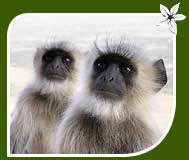
The Common Langur or
Hanuman Monkey
Latin Name : Presbytis
entellus
Local Name : Langur/Hanuman (Hindi), Wana (Marathi),
Kondamuchu (Telugu)
In
the seated posture, the common langur measures 60-75 cm in height. Its tail
is 90-100 cm in length. The weight of langurs varies depending to where they
belong. For instance, langurs from the Himalayas weigh between 16 and 28 kg
whereas those from the peninsular region have a weight of 9 to 16 kg. A
slight colour difference can also be noticed in langurs in accordance with
their habitat. Langurs of the Deccan region are pale in colour. The langurs
inhabiting the southeast Indian parts are almost white. Those that reside in
rainy regions have a darker colour.
The population of langurs is quite well distributed throughout India. From
the Himalayas in the north to Kanyakumari in far south, langurs can be found
everywhere. During winters in the Himalayas, the snow-laden pine and fir
trees make up the habitat of a langur. One can spot langurs in forests,
shady groves and around temples and tanks. The langurs are mostly seen in
groups of 15 to 25. They reproduce once every two years.
Tree Shrew
Latin Name : Tupaia lepcha
Local Name : Tree Shrew
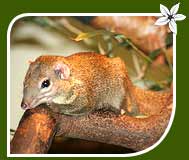
A
tree shrew looks much like a squirrel. However, in terms of habits, the
shrews are completely different from a squirrel. This animal species
inhabits dry and moist deciduous forests and can be found all over India
including Assam and Eastern Himalayas. Tree shrews have a liking for water.
It measures 18 to 20 cm in length, except the tail which is 23 cm itself.
The upper parts of this animal species are grizzled brown and its underparts
are buff coloured. The species prefers living in families.
The Hoolock or Whitebrowed Gibbon
Latin Name : Hylobates
hoolock (Harlan)
Local Name : Uluk (Hindi)
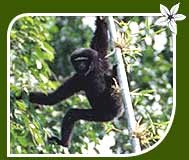
The
hoolock gibbon can be easily spotted in the forests of Assam and in the
Chittagong Hills of Bangladesh. This animal species inhabits mainly hill
forests and lives in a group of six. The group comprises parents and young
ones. In comparison to other heavier apes, the hoolock gibbons are mentally
very quick. The hoolock gibbon is 90 cm in height and weighs between 6 and 8
kg.
The family of a hoolock gibbon moves from treetop to treetop everyday. For
spending nights, they prefer sheltered valleys. The hoolock gibbon basically
feeds on fruit, leaves, spiders, grubs and other insects. Their howl can be
heard in warm sunlight. If the day is hot, the species likes to rest under
shady trees without making a noise. Mating occurs in the early rainy season
and breeding takes place between December and March.